
Yes, but not as a standalone job title. The $300,000 “prompt engineer” roles from 2023 are gone, and postings using that exact title are down roughly 30%. Meanwhile, postings listing prompt engineering as a skill inside other roles are up 250%, and the underlying techniques now sit underneath every serious AI Engineer, AI Trainer, and AI Agent Architect job in 2027.
Job postings for “prompt engineer” have cratered. The $300,000 salaries reporters wrote about in 2023 are gone. And still, prompting technique shows up inside more 2026 job descriptions than almost any other AI-adjacent skill tracked by hiring platforms. Both of those things are true at the same time, and reconciling them is the entire point of this guide.
The short version: the job title died. The skill got absorbed into nearly every technical and content role that touches AI, and it’s now worth more paired with something else than it ever was standing alone. What follows is the data behind that claim, what actually replaced the narrow “prompt engineer” job, which prompting techniques still measurably work, and a practical path for learning this in 2027 without wasting time on a title that isn’t hiring anymore.
This isn’t a niche question for AI researchers. Anyone deciding whether to take a prompt engineering course this year, whether to list it as a skill on a resume, or whether to keep paying for a certification program is making a real bet with real time and money attached, and the honest answer depends entirely on what they’re betting on: the title, which is a bad bet, or the underlying technique paired with something else they already know, which is a considerably better one.
What Happened to Prompt Engineering Between 2023 and 2026
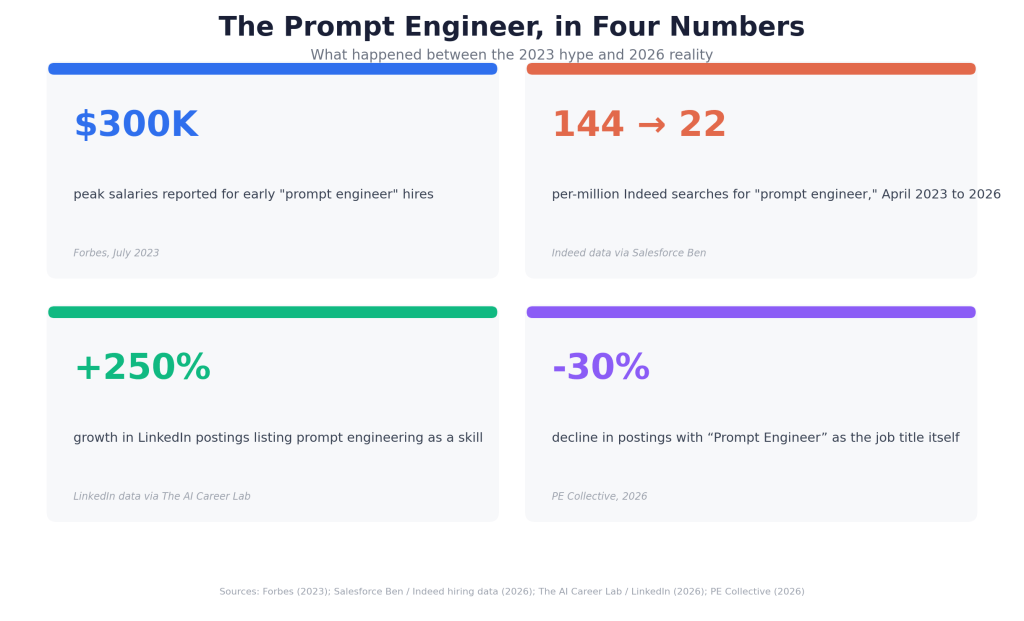
In July 2023, Forbes ran a story on AI prompt engineers earning up to $300,000 a year, often with no technical degree required. It was the perfect AI-boom story: a brand-new job, absurd pay, low barrier to entry. Bootcamps and course platforms spun up within months. LinkedIn filled with “prompt engineer” in people’s headlines.
Three years later, the data tells a different story. Indeed search volume for “prompt engineer” peaked around 144 searches per million in April 2023 and has since plateaued at 20 to 30 per million, roughly an 80% drop from the peak. Microsoft’s own workforce research ranked prompt engineer second-to-last among new roles companies planned to hire for over the following 12 to 18 months. Jared Spataro, a Microsoft executive quoted in that reporting, put it plainly: “You don’t have to have the perfect prompt anymore.” Models got better at handling imperfect, conversational instructions, which quietly erased the reason the narrow specialist role existed.
The Nationwide CTO, quoted in the same piece, framed the shift from the hiring side: prompt engineering became “a capability within a job title, not a job title to itself.” That’s the pattern, and it isn’t a new one.
A familiar pattern in tech hiring
“Webmaster” is the closest historical parallel. In the mid-1990s, simply knowing HTML was rare enough to be a standalone job, and companies hired dedicated webmasters to build and maintain what was, at the time, a genuinely novel kind of asset. Within a decade, basic web skills had spread into design, marketing, and engineering roles broadly enough that “webmaster” as a standalone title mostly disappeared, not because websites stopped mattering, obviously, but because the skill required to make one stopped being scarce enough to justify its own job category.
“Social media expert” followed the same arc roughly fifteen years later: a genuinely new skill in 2009, a standalone job title by 2012, and by the early 2020s mostly folded into broader marketing and content roles, because understanding how to post on social platforms stopped being a specialty and became a baseline expectation of anyone in marketing. “Mobile app developer” partially followed this arc too, though less completely, since building for a specific platform stayed technical enough that it kept more of its specialist status than either of the other two examples.
Prompt engineering is running the identical playbook on a much faster timeline: roughly three years from Forbes’ $300,000 story to the plateaued search volume and contracting title share documented above, compared to the decade or so “webmaster” took to complete the same arc. The compression itself is the more interesting data point than the decline: AI-adjacent hype cycles are now resolving in a third of the time older tech hype cycles took, a signal about how fast the underlying tools are maturing generally, beyond anything specific to prompting.
A Short History: How We Got From GPT-3 to Context Engineering
Understanding why the field moved so fast requires seeing how young it actually is. The entire discipline is younger than most people’s current job.
It starts in May 2020, when OpenAI researchers published “Language Models are Few-Shot Learners,” the GPT-3 paper, showing that a large enough model could learn a new task from a handful of examples in the prompt itself, no retraining required. That single finding is the seed of everything that followed: if examples in the prompt could steer behavior, then the prompt itself became a lever worth optimizing.
The next real jump came in January 2022, when Jason Wei and coauthors at Google published “Chain-of-Thought Prompting Elicits Reasoning in Large Language Models”, showing that simply asking a model to reason step by step before answering dramatically improved performance on math and logic tasks. This is the paper behind the chain-of-thought technique still covered below, four years later, as one of the small number of methods with real evidence behind it.
Nine months after that, in October 2022, a separate team published “ReAct: Synergizing Reasoning and Acting in Language Models”, the paper that first combined a model’s reasoning with the ability to take actions and observe results, interleaving “thought,” “action,” and “observation” steps. ReAct is the direct ancestor of every modern AI agent: the pattern of a model reasoning, calling a tool, reading the result, and reasoning again is ReAct’s core loop, just with better models and more tools attached to it three years later.
By 2023, researchers had pushed further with Tree of Thoughts, letting a model explore several reasoning paths in parallel and backtrack from dead ends instead of committing to one linear chain, and 2023 was also the year “prompt engineer” became a hireable job title with a six-figure salary attached, as the Forbes story above captured. The techniques kept maturing while the job title around them inflated, and by June 2025, when Karpathy reframed the field as context engineering, the two tracks, the technique and the title, had already started to diverge. The title peaked and cracked. The technique kept compounding, one paper at a time, into the discipline this guide describes in 2027.
Is Prompt Engineering Dead? What the Data Actually Shows
Here’s where the “prompt engineering is dead” framing breaks down. LinkedIn postings tagging prompt engineering as a skill, as opposed to a job title, grew roughly 250% over the same period the standalone title was declining. PE Collective’s 2026 analysis found that roles requiring prompt engineering ability grew 3x between 2024 and 2026, even as postings with the literal job title fell about 30%.
Pay tells the same story from a different angle. Entry-level compensation for roles requiring prompt skills climbed from a $75,000 to $100,000 band in 2024 to $90,000 to $125,000 in 2026. Mid-level roles run $130,000 to $175,000, senior roles $170,000 to $220,000, and AI engineers who combine prompting ability with actual software engineering earn 15 to 25% more than peers without it. The skill didn’t get cheaper. It got folded into higher-paying jobs that also demand something else: engineering ability, domain expertise, or product judgment.
That “something else” is the whole story. Professionals who had only prompting, nothing else, are the ones whose job prospects genuinely declined. Professionals who paired prompting with an existing specialty, law, medicine, marketing, software engineering, came out ahead, because the combination is rarer and more valuable than either skill alone. If you’re evaluating whether to learn this in 2027, that’s the fork in the road: prompting as your entire professional identity is a bad bet, prompting as a force multiplier on a skill you already have is a genuinely strong one.
It’s worth taking the “dead” argument seriously rather than dismissing it, because part of it is correct. If your plan was specifically to get hired under the job title “prompt engineer,” at a company treating that as a standalone specialist role the way it hired a standalone “webmaster” in 1998, that plan is dead, and the Indeed and Microsoft data above says so plainly. Where the argument overreaches is treating the job title’s decline as evidence the underlying skill stopped mattering, when the LinkedIn and PE Collective numbers show the opposite: demand for the skill kept climbing at the exact same time the title was shrinking. Those aren’t contradictory data points once you see them as two different measurements. One tracks a job posting’s literal title. The other tracks what employers actually expect a hire to be able to do, regardless of what the posting is called, and the second number is the one that’s been growing this whole time.
From Prompt Engineering to Context Engineering
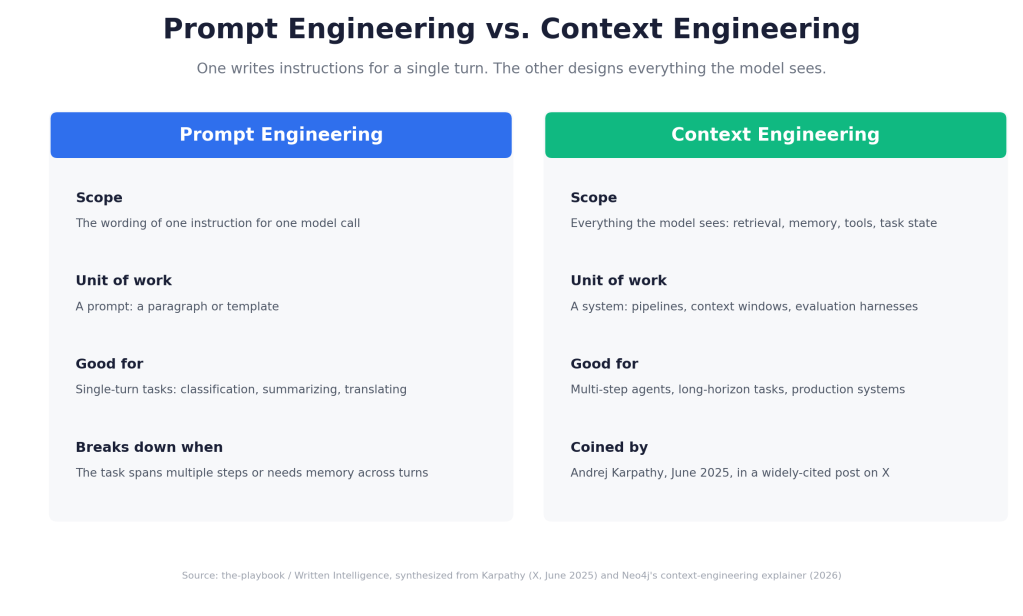
The clearest signal of where the field moved came from Andrej Karpathy, former OpenAI and Tesla AI lead, in a June 2025 post that’s now widely cited as the moment the term crystallized: “+1 for ‘context engineering’ over ‘prompt engineering’. People associate prompts with short task descriptions you’d give an LLM in your day-to-day use. When in every industrial-strength LLM app, context engineering is the delicate art and science of filling the context window.”
The distinction matters practically, well beyond wording. Prompt engineering is the wording of one instruction for one model call. Context engineering is the entire information architecture around an ongoing interaction: what gets retrieved, what’s held in memory, which tools the model can call, and what state carries across steps. Neo4j’s explainer draws the line cleanly: prompt engineering handles the one-time textual instructions given to an LLM, while context engineering handles the contextual information architecture for the ongoing interactions.
That distinction predicts exactly where each discipline succeeds and fails. Prompt engineering alone still works fine for single-turn tasks: classification, translation, a one-shot summary, a simple chatbot reply. It breaks down the moment a task spans multiple steps and the system has to remember what it already found out, which describes almost every AI agent built in 2026 and 2027. An agent diagnosing a production outage needs structured knowledge about service dependencies and recent changes, the kind a knowledge graph or a retrieval system supplies, not a cleverer paragraph of instructions.
This is also exactly where prompting and safety stop being separate concerns. An agent with well-engineered context but no operational guardrails is still a liability: it can execute the right multi-step plan built on a manipulated instruction just as easily as a poorly-prompted one, since neither problem is about the wording of the original prompt. If you’re building or evaluating agentic systems in 2027, our guide to AI guardrails covers the six types of controls that catch what good context alone won’t: prompt injection, unauthorized tool calls, and the operational limits that stopped one AI coding agent from wiping a production database in 2026.
A worked comparison makes the gap concrete. Prompting a model to “summarize this customer’s support history and suggest next steps” is prompt engineering, one instruction, one call, done. Building the system behind an agent that pulls that customer’s full ticket history from a database, checks their subscription tier against a separate billing system, retrieves the company’s current refund policy from a knowledge base rather than the model’s training data, and only then drafts a recommendation, while logging every step for audit, is context engineering. The second system needs the first system’s prompting skill nested inside it dozens of times over, at every step where the agent has to turn retrieved information into a decision, which is why context engineering is better understood as a superset of prompt engineering than a replacement for it.
The Techniques That Still Work in 2027
None of this means the actual craft of writing a good prompt stopped mattering. Several specific techniques still produce measurable gains, and knowing which ones is more useful than a general sense that “prompting still matters.” The table below is the fast version; the detail on each technique, including which failure mode it actually fixes, follows.
| Technique | What it does | Measured gain | Best for |
|---|---|---|---|
| Chain-of-thought | Model reasons step by step before answering | Up to 61% over zero-shot | Math, logic, multi-step analysis |
| Few-shot | 3-5 examples shown, no reasoning chain | 15-30% accuracy gain | Consistent format and tone |
| XML/delimiter structuring | Tags separate instructions, context, examples | Improved parsing reliability | Long, multi-part prompts |
| Role/persona assignment | Model is assigned a specific expert identity | Measurable quality shift | Domain-specific tone and depth |
| Self-consistency | Same prompt run multiple times, most common answer kept | Biggest gain from 1 to ~5 samples | High-stakes math and logic answers |
| Tree of Thoughts | Multiple reasoning branches explored, weak ones pruned | Substantially outperforms single-chain methods | Multi-step problems with no easy recovery from an early mistake |
| Automated optimization (OPRO) | A model generates and tests candidate prompts itself | ~8% over human-designed prompts | Optimizing a prompt already in production |
Chain-of-thought prompting, asking a model to show its intermediate reasoning before the final answer, still delivers up to a 61% accuracy improvement over a zero-shot baseline on math, logic, and multi-step analysis tasks. Few-shot prompting, giving the model three to five high-quality examples of the task without reasoning chains, delivers a smaller but real 15 to 30% accuracy gain, and it’s the most reliable way to lock in a consistent output format or tone.
Structuring prompts with XML-style tags, wrapping instructions, context, and examples in <instructions>, <context>, and <examples> blocks, measurably improves how reliably a model parses complex, multi-part requests, especially as prompts get longer and more structured for production use. Assigning the model a specific role or persona (“you are a senior tax attorney reviewing this clause”) continues to shift output quality in ways that are easy to test and cheap to apply.
Self-consistency, an extension of chain-of-thought, runs the same reasoning prompt multiple times and keeps the answer that shows up most often across the runs, on the logic that a correct chain of reasoning is more likely to recur than any one specific wrong path. The research behind it found the biggest jump comes from going from one sample to about five, with returns flattening out around forty samples, and gains that hold consistently across math benchmarks like GSM8K and commonsense reasoning tasks like StrategyQA. It costs more in compute, since the model runs several times per question, which is exactly why it’s reserved for the reasoning tasks where a wrong answer is expensive rather than applied by default everywhere.
Tree of Thoughts, introduced by Yao and colleagues in 2023, goes a step further than self-consistency by letting a model explore multiple reasoning branches at once instead of picking one path and running it several times. At each step the model generates several candidate next-thoughts, evaluates them as promising, uncertain, or dead ends, and can backtrack, the way a person solving a puzzle abandons a branch that stopped making sense. On tasks like the Game of 24, a math puzzle requiring several sequential decisions with no easy way to recover from an early mistake, this substantially outperforms both plain chain-of-thought and self-consistency, precisely because the failure mode it targets, one bad early step ruining everything downstream, is what a single linear reasoning chain can’t recover from.
The newest addition is automated prompt optimization, sometimes called OPRO, where the optimization loop itself is handed to a model: it generates candidate prompts, tests them against real examples, and iterates. Early benchmarks show roughly an 8% improvement over human-designed prompts on the same tasks, which is a meaningful signal that the manual, trial-and-error version of prompt writing is itself becoming an automatable step rather than a hand-crafted one. That’s worth sitting with: even the task of prompting is starting to get prompted.
None of these techniques is exotic anymore. What separates someone worth hiring in 2027 from someone who took a weekend course isn’t knowing that chain-of-thought exists. It’s knowing which of these five or six techniques actually fits a given failure mode, since a self-consistency pass wastes compute on a task that chain-of-thought alone already solves, and Tree of Thoughts is overkill for a single-turn classification job that a well-structured few-shot prompt handles in one call.
The New Jobs Absorbing the Prompt Engineer
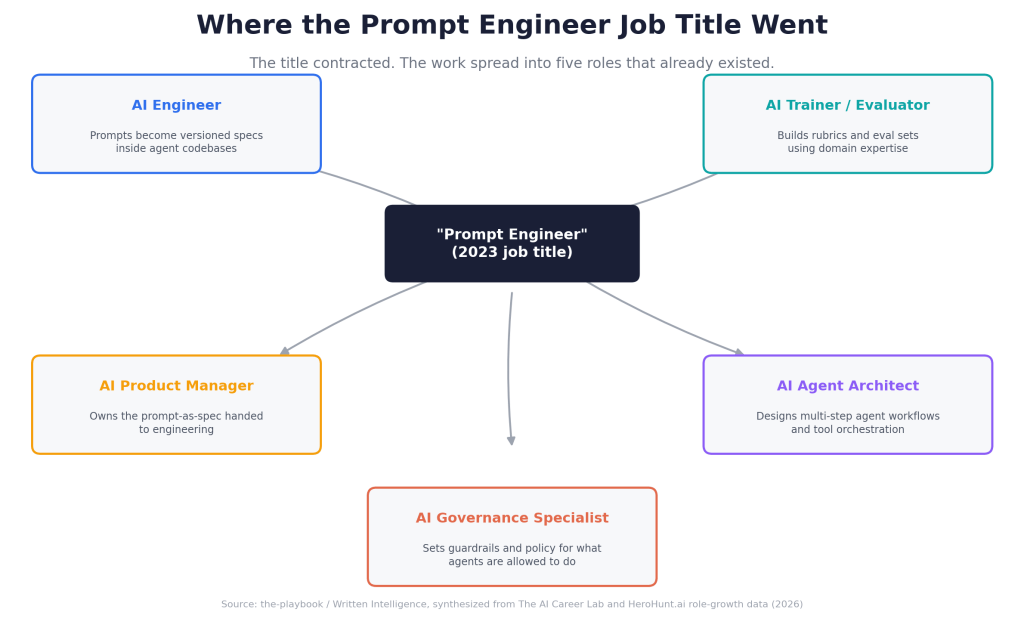
If the job title contracted, where did the demand go? It didn’t vanish. HeroHunt.ai’s 2026 role-growth rankings, tracking the fastest-growing AI job categories by year-over-year posting volume, help answer that precisely: AI Engineer alone grew 143% year-over-year to become the single fastest-growing job in the US, and several of the roles just beneath it in the rankings are, in practice, prompt engineering wearing a different name. Five roles absorbed most of the demand, and understanding them is the fastest way to see what “learning prompt engineering” should actually target in 2027.
AI Engineer is the biggest single destination. It’s the fastest-growing job in the US by year-over-year postings, up roughly 143%, and it’s where prompts stopped being “clever paragraphs” and became versioned specifications living inside a codebase, complete with test suites and evaluation harnesses. AI Trainer or Evaluator roles use prompting skill combined with domain expertise to build the rubrics and evaluation sets that determine whether a model’s outputs are actually good, work that requires understanding both the subject matter and how to phrase a test case precisely.
AI Product Manager is where the prompt becomes a specification handed from product thinking to engineering execution, prompt fluency paired with judgment about what the product should actually do. AI Agent Architect is a newer, fast-rising title tied directly to the shift toward multi-step systems: with roughly 40% of enterprise applications expected to embed AI agents by the end of 2026, someone has to design the workflows, tool orchestration, and context architecture those agents run on.
And AI Governance Specialist, growing at roughly 45% year-over-year, is where prompting expertise turns into policy: setting the rules for what an agent is and isn’t allowed to do, the same territory this site’s guide to AI guardrails covers in depth, from input filtering to the operational limits that stop an autonomous agent’s mistake from cascading into a real incident.
What this looks like day to day differs more than the shared “prompt engineering” label suggests. An AI Engineer spends a working session inside a code editor, adjusting a system prompt, running it against a test suite of two hundred cases, and committing the change with a note on which failure it fixed. An AI Trainer spends that same session reading a stack of model outputs against a rubric they wrote, flagging where the model’s reasoning went wrong and why, work that looks more like grading essays than writing code. An AI Agent Architect spends it mapping out which tools an agent needs access to for a given workflow and in what order, closer to systems design than either of the other two. All three are, technically, doing prompt engineering. None of their job descriptions say so, which is exactly why searching for “prompt engineer” postings undercounts how much of this work actually exists in the market.
Where Prompting Still Pays Off Most, by Field
The return on learning this skill isn’t uniform across industries, and the PE Collective salary premium, 15 to 25% for those who pair prompting with another skill, plays out differently depending on what that other skill is.
Marketing, content, and SEO is where the combination compounds hardest, and it’s the field most of this site’s readers work in. Someone who understands search intent, what actually earns a citation in an AI Overview, and how a brand’s voice should sound, and can also write a precise, well-structured prompt for research or first-draft generation, produces work that a generic prompt user or a generic writer can’t match alone. The seo-copywriting discipline behind pieces like this one is itself a form of applied prompt and context engineering: structuring inputs, defining format, and setting constraints so an AI-assisted draft comes out usable rather than generic.
Software engineering treats prompting as one tool among several rather than a specialty, which is exactly why the AI Engineer title absorbed so much of the 2023 hype. A senior engineer who can write a tight system prompt for an agent, define its tool access, and build an evaluation suite around it is doing prompt engineering, context engineering, and traditional software engineering in the same afternoon, and the job market pays for that specific combination rather than for prompting alone.
Legal and compliance work rewards precision above everything else, which happens to be what good prompting is built around: scoping exactly what a model should and shouldn’t do with a contract clause, and building in the output guardrails that catch a hallucinated citation before it reaches a filing, the exact failure mode covered in the Mata v. Avianca case in our guardrails guide. A lawyer who treats an AI research tool as infallible is the risk; one who prompts it carefully and verifies the output is the asset.
Healthcare is similar but higher-stakes, where prompting skill has to be paired with both clinical judgment and a working knowledge of what HIPAA actually requires from an output. Customer support and operations roles increasingly use prompting to build and refine the scripts and escalation logic behind support chatbots, which is precisely the surface area where a badly scoped prompt turned into the Air Canada bereavement-fare incident and the Chevrolet dealership’s $1 Tahoe. The teams doing this well in 2027 are the ones who understand that a support chatbot’s prompt is also, functionally, a compliance document.
Education and training is a smaller but fast-growing use case, where instructors and instructional designers prompt models to generate practice problems, rubric-aligned feedback, and differentiated materials for students at different levels, work that rewards pedagogical judgment as much as prompting technique. And sales and business development roles use prompting to personalize outreach at a scale that used to require a much larger team, though the field has a well-documented failure mode of its own: generic, obviously-templated outreach that a recipient can spot in one sentence, which is a prompting failure as much as a strategy one, since the fix is almost always a more specific, better-contextualized prompt rather than a different tool.
Who Should Learn Prompt Engineering in 2027 (and Who Shouldn’t)
Software engineers building with AI should learn it, but as one part of a larger skill set that includes evaluation design and, increasingly, context engineering fundamentals. Treat prompting the way you’d treat learning a new API: necessary, quick to pick up the basics, and worthless as a standalone resume line without the engineering skill it plugs into. The practical move is to build prompting into whatever you’re already shipping, an internal tool, a feature, a side project, rather than treating it as a separate line of study to finish before you get back to real engineering work.
Marketers, content strategists, and SEO professionals, the audience most likely reading this on Written Intelligence, should absolutely learn it, and the return is higher here than almost anywhere else, because prompting paired with genuine subject-matter judgment is exactly the combination the PE Collective salary data rewards. Someone who understands what makes content rank and can also write a precise, well-structured prompt for an AI research or drafting tool has a real edge over someone with only one of those two skills. In practice that means learning to prompt for the specific stages of content work where it earns its keep, research synthesis, first-draft structure, headline testing, rather than trying to prompt an entire finished article in one pass and being disappointed when it reads like it was written in one pass.
Non-technical professionals in law, healthcare, finance, and similar fields should learn the basics for the same reason: domain expertise plus prompting fluency is the combination that survived the 2026 correction, while prompting alone did not. A paralegal who can write a tight, well-scoped prompt for contract review is more valuable than one who can’t, and dramatically more valuable than a prompt specialist with no legal training at all. The starting point here is narrower than it sounds: pick the one or two recurring tasks in your actual job, a specific document type, a specific kind of client question, and get good at prompting for exactly those, rather than trying to become generically “good at AI” first.
Students and early-career professionals hoping to build a career on prompting alone are the group that should recalibrate. The data is specific here: the narrow “prompt engineer” title is contracting, not growing, and betting a career on a job title in active decline is a weak strategy no matter how interesting the underlying skill is. Learn prompting as a component of a computer science, product, or domain-expert path instead of as the destination itself, and be skeptical of any course or certificate that presents “prompt engineer” as a standalone career outcome rather than one skill among several a real job will expect.
Career changers coming from an unrelated field sit in the most ambiguous spot, and the honest advice is to pick the destination role first, AI Trainer, AI Product Manager, whichever fits your background, and learn prompting as one requirement of that specific job rather than as a general credential you’ll figure out how to use later. Prompting in the abstract, detached from a target role, is the version of this skill the job market has already stopped rewarding.
How to Actually Learn It in 2027: A Practical Framework
Step 1. Learn the techniques that actually have evidence behind them. Chain-of-thought, few-shot examples, XML-style structuring, role assignment, self-consistency, and Tree of Thoughts, covered above with real performance numbers, not the hundred looser “tips and tricks” lists circulating online. Depth on six techniques, and knowing which failure mode each one solves, beats shallow familiarity with forty. Budget a week for this, not a month: the techniques themselves are simple once you’ve seen the pattern, and reading about them longer than that just delays the part that actually builds skill.
Step 2. Practice on real evaluation tasks, not toy prompts. The people who commanded premium salaries in 2026 weren’t the ones who could write a cute prompt. They were the ones who could build a rubric, test a prompt against fifty real examples, and say precisely where and why it failed. Pick a real task in your field, drafting a specific kind of email, classifying a specific kind of support ticket, summarizing a specific kind of document, and build an actual evaluation set for it: twenty to fifty real examples with a human-judged correct answer for each, so you have something concrete to test a prompt against instead of a gut feeling about whether it “seems good.”
Step 3. Learn the fundamentals of context engineering, even at a basic level. You don’t need to build a production retrieval system to understand what one does. Understanding how memory, retrieval, and tool access shape a multi-step agent’s behavior is what separates someone who can prompt a chatbot from someone who can reason about an agent, and that gap is exactly where the AI Agent Architect role lives. Concretely, that means learning what retrieval-augmented generation actually retrieves and why it can retrieve the wrong thing, how an agent’s memory persists or doesn’t across a session, and what happens when a tool call returns something the prompt never anticipated.
Step 4. Pair it with a skill you already have. This is the single highest-impact step, and the data above backs it directly: prompting plus domain expertise consistently out-earns and out-lasts prompting alone. If you’re in marketing, learn to prompt for content and campaign work specifically, not generic copywriting demos. If you’re in law, learn to prompt for contract analysis specifically, using real (anonymized) contract language, not a textbook example. Generic prompting practice teaches you less than focused practice inside your actual field, because the evaluation criteria for “is this a good output” only get sharp once they’re tied to work you’d actually be judged on.
Step 5. Build one real, end-to-end project. Not a demo. Something with an actual evaluation set, actual failure cases you had to fix, and ideally something that runs as a small agent with more than one step, since that’s the shape of almost all production AI work now. A worked example: a tool that reads a batch of customer support tickets, classifies each one, drafts a response, and flags anything it’s uncertain about for a human to review, tested against fifty real tickets with a written note on where the first version failed and what you changed. That’s the project that goes on a resume, not “completed a prompt engineering course.”
Step 6. Learn the basics of guardrails and evaluation before you ship anything that acts on real data. This is the step most self-taught prompt learners skip entirely, and it’s increasingly the difference between a hobby project and something a company will actually deploy. Understanding input and output filtering, operational limits, and why an agent needs approval before touching production systems isn’t a separate specialty anymore; it’s baseline literacy for anyone building with AI in 2027, the same way understanding basic security hygiene became baseline literacy for web developers a decade earlier rather than staying a niche specialty.
A few mistakes are common enough at every step above to call out directly. Learning prompting in isolation, with no domain attached, is the single biggest one, since the data throughout this guide shows that’s precisely the profile whose job prospects declined. Treating a prompt engineering certificate as equivalent to a portfolio project is another: employers in 2026 consistently valued a demonstrated, evaluated project over a course completion badge. And skipping the evaluation step, tuning a prompt against a handful of examples you eyeballed rather than a real test set, produces prompts that look good in a demo and fail in production, which is exactly the gap the AI Trainer and Evaluator roles above exist to close.
A subtler mistake is reaching for the most sophisticated technique available instead of the right one for the task. Someone who’s just learned Tree of Thoughts and self-consistency will sometimes apply both to a simple classification task that a well-structured few-shot prompt already handles reliably, burning compute and adding latency for no measurable gain. The comparison table earlier in this guide exists specifically to prevent that: matching technique to failure mode is the actual skill, not knowing that the more advanced techniques exist.
Final Thoughts
The job title died. The skill didn’t, it just stopped being enough on its own. Every data point in this guide points the same direction: prompting paired with real engineering ability, domain expertise, or evaluation rigor is worth more in 2027 than it’s ever been, while prompting as a standalone credential is chasing a job market that’s already moved on. Learn the techniques that have actual evidence behind them, attach them to something you’re already good at, and treat context engineering and basic guardrail literacy as the next layer rather than someone else’s job.
The webmaster and social-media-expert comparisons earlier in this guide aren’t just historical color. They’re the actual precedent for what happens next: the skill keeps compounding in value for the people who build it into a real specialty, and the job title fades from job boards without the skill fading from job descriptions. Nobody in 2027 asks whether “knowing HTML” was worth learning. In a few more years, “prompt engineering” will likely sound like an equally strange thing to have ever debated, not because it stopped mattering, but because it will have quietly become assumed.
Frequently Asked Questions
Is prompt engineering still a real job in 2027?
As a standalone job title, it’s a shrinking one, down roughly 30% in postings since its 2023 peak. As a skill embedded in other roles, AI Engineer, AI Trainer, AI Product Manager, it’s more in-demand than ever, with roles requiring it growing 3x between 2024 and 2026.
What replaced prompt engineering?
Context engineering is the closest technical successor, covering the full information architecture around an AI system rather than just the wording of one instruction. Organizationally, the work spread into AI Engineer, AI Trainer or Evaluator, AI Product Manager, AI Agent Architect, and AI Governance Specialist roles.
Should I still learn prompt engineering if I’m not technical?
Yes, especially if you pair it with expertise you already have. The salary and demand data both show that prompting combined with a domain specialty, marketing, law, healthcare, held up far better than prompting on its own.
Is chain-of-thought prompting still effective in 2027?
Yes. It remains one of the most reliably effective techniques, delivering up to a 61% accuracy improvement over zero-shot prompting on reasoning-heavy tasks, and it hasn’t been displaced by newer techniques so much as supplemented by them.
What’s the difference between prompt engineering and context engineering?
Prompt engineering writes the instructions for a single model interaction. Context engineering designs the full system around an ongoing interaction, including retrieval, memory, tool access, and task state, which is why it’s the more relevant discipline for building AI agents rather than simple chatbots.
Will prompt engineering matter at all by 2028?
The core techniques, chain-of-thought, few-shot examples, clear structuring, are unlikely to disappear, since they reflect how these models process instructions at a fairly fundamental level. What will keep changing is the job title wrapped around them, and betting on the underlying skill rather than the title has been the correct call at every point in this story so far.
Are prompt engineering certifications worth paying for in 2027?
Treat them skeptically unless the program is tied to a specific, verifiable outcome, a real project, a portfolio piece, an evaluation set you built yourself, rather than a certificate of completion. The AI Career Lab data above found employers consistently valued a demonstrated project over a course badge, which means the certificate itself is rarely the thing doing the work of getting someone hired.
Is Tree of Thoughts or self-consistency overkill for everyday use?
For most everyday tasks, yes. Both techniques cost meaningfully more compute than a single well-structured prompt, and neither is worth reaching for on a task that plain chain-of-thought or a good few-shot example already solves reliably. They earn their cost specifically on high-stakes, multi-step problems where a wrong answer is expensive and a single linear reasoning chain is prone to compounding an early mistake.
How long does it take to become good at prompt engineering?
The techniques themselves take a week or two to learn at a basic level, since there are only a handful with real evidence behind them. Becoming genuinely good, in the sense that produces the salary premium discussed above, takes longer, because it requires building real evaluation judgment inside a specific domain, which is a skill measured in months of real practice, not a weekend course.
Do I need to know how to code to learn prompt engineering?
No. Chain-of-thought, few-shot prompting, and role assignment all work through plain text in any chat interface. Coding becomes relevant only once you move toward context engineering and agent building, Step 3 and beyond in the framework above, where you’re wiring together retrieval, memory, and tool calls rather than just writing instructions.
Is prompt engineering the same as being good at using ChatGPT?
Not quite. Knowing how to get a decent answer out of a chatbot in casual use is closer to basic AI literacy, something most people picked up by 2025 without formal study. Prompt engineering, in the sense this guide means it, is the more rigorous version: knowing which specific technique fixes which specific failure mode, and being able to test that systematically rather than by feel.
What’s the biggest mistake people make when learning this skill in 2027?
Learning it as an isolated credential instead of attaching it to a domain or an engineering skill they already have. Every data point in this guide points the same direction: the people whose job prospects actually improved were the ones who paired prompting with something else, and the people whose prospects declined were the ones treating prompting as a complete professional identity on its own.
Keep reading:
 written-intelligence.com